
More IT Investment Doesn’t Always Translate into Better Fraud Prevention in Banking
Why 70% of banks increased their fraud prevention budgets and still see rising losses—and what the 31% that are succeeding are doing differently.
The 2025 Gartner Survey on Fraud Detection and Anti-Money Laundering gathered insights from 150 senior leaders in the banking sector across North America, EMEA, Asia-Pacific, and Latin America. The findings challenge a widespread assumption: that spending more almost automatically leads to better detection. The study also identifies the specific capability gaps that separate institutions achieving over 80% preventive detection from those that still react only after losses have already occurred.
-
Reading time: 3 minutes
-
Gartner® research published in March 2026
ID G00846089 -
Page published in 10 of July 2026
The gap that more budget doesn’t close
Financial fraud losses continue to rise, even with record levels of investment in prevention. The Gartner survey highlights three converging challenges that rule-based systems and MFA alone can no longer address:
-
Authorized fraud: the legitimate user approves the transaction after being manipulated through social engineering. It remains invisible to anomaly detection.
-
Injection attacks: deepfakes and synthetic signals introduced directly into the biometric pipeline, bypassing liveness detection before any transaction rule is triggered.
-
Detection without explainability: risk decisions that cannot be traced, audited, or defended before a regulator when an incident occurs.
Data you can’t ignore
53%
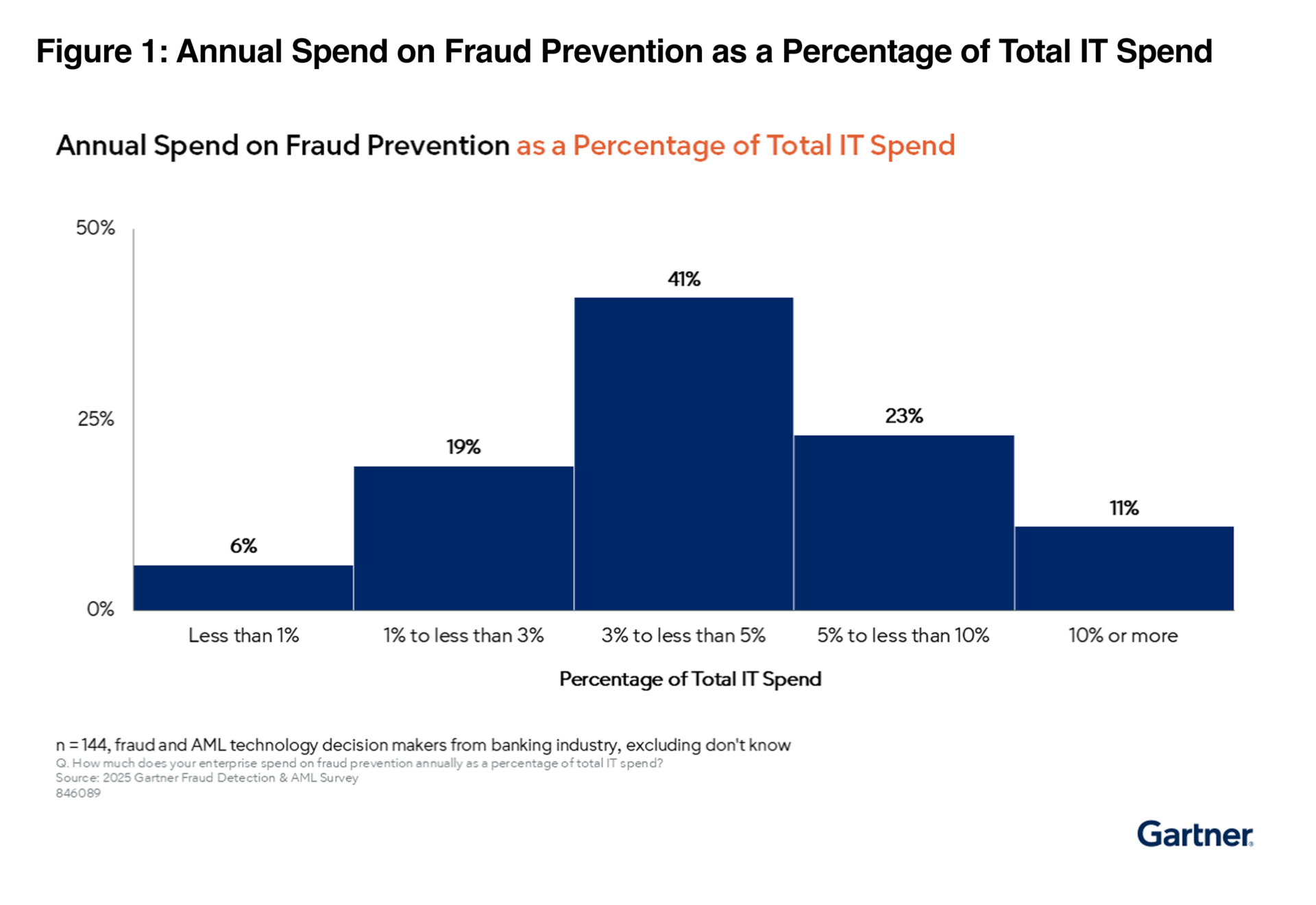
of banks increased their fraud prevention budgets by more than 5% over the past three years, yet most still report rising losses
70%
of banks continue to experience increased fraud losses despite sustained investment growth over the last three years
31%
only 31% of banks achieve preventive fraud detection rates above 80%. More than a third detect less than 60%—meaning detection happens after losses have already materialized
Rule-based systems and MFA are no longer sufficient against today’s threat vectors. Gartner identifies injection attack detection, layered defenses, and audit-ready explainability as the key capability priorities for institutions aiming to move into the top tier.
Why we believe this matters
Gartner® identifies behavioral anomaly detection, injection attack detection, and explainability as priority investments for banking CIOs facing spikes in social engineering, account takeover, and identity fraud. These are precisely the capabilities that Facephi has built, certified, and deployed across more than 150 financial institutions in over 25 countries.
Facephi’s anti-fraud intelligence platform and its alignment with Gartner’s research:
Facephi delivers a layered anti-fraud intelligence platform that addresses the three critical capability gaps identified in the Gartner survey: identity verification resilient to injection attacks, iBeta Level 1+2 certified with a 0% attack success rate; audit-ready explainability, which traces every risk decision back to the original verification event using named, human-readable signals; and deployment sovereignty, whether in on-premises Kubernetes or private cloud, ensuring data never leaves the institution’s governance perimeter.
 If you are experiencing a rise in social engineering scams, authorized push payment (APP) fraud, phishing incidents, and account takeover, and have not yet invested in behavioral biometrics and device intelligence, these are the areas you should prioritize.
Gartner®, Higher IT Spending Doesn’t Always Lead to Better Fraud Prevention in Banking, Vatsal Sharma, marzo de 2026 · G00846089
Download the full Gartner® research
and benchmark your anti-fraud stack against the findings from 150 banks worldwide.
Gartner®, Higher IT Spending Doesn’t Always Lead to Better Fraud Prevention in Banking (Part 2), Vatsal Sharma, March 9, 2026, ID G00846089
Gartner® does not endorse any vendor, product, or service referenced in its research publications, nor does it advise technology users to select only those vendors with the highest ratings or other designations. Gartner research publications reflect the opinions of the Gartner Research & Advisory organization and should not be interpreted as statements of fact. Gartner disclaims all warranties, express or implied, with respect to this research, including any warranties of merchantability or fitness for a particular purpose.
GARTNER® is a registered trademark and service mark of Gartner, Inc. and/or its affiliates in the United States and internationally and is used herein with permission. All rights reserved.